Best Large-Format Budget 3D Printer: The Sovol SV08 Max Review
The fastest way to get a large-format printer under $400 in 2025 is the Sovol SV08 Max. If you’re new to printing and want something that runs your first Benchy in under 20 minutes, the Anycubic Kobra X at ~$230 is the safer bet. The choice comes down to how much build volume you actually need and how much tuning you’re willing to do.
Below, we break down the top contenders, tie every spec to a real outcome, and flag the compromises most reviews skip.
Best budget 3d” /> printer 2025: Top Picks & Guide
The top budget pick: Sovol SV08 Max
The SV08 Max gives you 300×300×320 mm of build space for about $400 – roughly double the volume of a standard Ender 3 for only $150 more. That ratio makes it the best value for anyone printing helmet halves, functional brackets, or cosplay armor in one piece.
Specs that matter to print results:
- Build volume: 300 × 300 × 320 mm (11.8 × 11.8 × 12.6 in) – fits a full-size mandalorian helmet shell without splitting the file.
- Nozzle temp: 300°C max – opens up PETG, ABS, and basic nylon blends.
- Practical print speed: 80–100 mm/s at 0.2 mm layer height with a 0.4 mm nozzle. Above 100 mm/s you’ll see ringing until you enable input shaping.
- Bed: Removable PEI-coated spring steel, 220°C max – good adhesion for PLA and PETG without glue stick.
- Assembly: 90% pre-assembled, about 40 minutes from box to first print.
Practical implication for your choice: If you currently split large models into multiple parts because your printer can’t handle the full size, the SV08 Max removes that pain point. You’ll spend less time gluing and post-processing. If you mostly print desk toys and phone stands, the extra build volume is wasted space that hogs your desk.
Verification step: Measure your workspace. The printer footprint is roughly 500×500 mm with cable clearance. Confirm you have a level surface at least 20 inches wide and 20 inches deep. Also verify that your slicer (Cura, PrusaSlicer, OrcaSlicer) has a machine profile for the SV08 – most do, but if you use Simplify3D you may need to manually enter the bed dimensions.
Realistic limitation: The larger gantry amplifies ringing and z-banding if you don’t tighten belts and PID-tune the bed. Expect to spend your first hour on calibration cubes and belt tension adjustments before you trust an overnight print. Beginners often mistake this as a defect – it’s normal for the size.
Who should skip it: Anyone who expects “set it and forget it” reliability. The Kobra X or a Bambu Lab A1 will frustrate you less.
How the top budget printers compare
This table focuses on the specs that actually change what you can print, not the ones that fill spec sheets.
| Printer | Build Volume (mm) | Max Nozzle Temp | Practical Speed | Assembly Time | Price (approx.) | Best For |
|---|---|---|---|---|---|---|
| Sovol SV08 Max | 300×300×320 | 300°C | 80–100 mm/s | 40 min | ~$400 | Large single parts, functional prints |
| Anycubic Kobra X | 250×220×220 | 260°C | 60–80 mm/s | 15 min | ~$230 | Beginners, fast first print, small-medium parts |
| Creality Ender 3 V3 SE | 220×220×250 | 260°C | 60–80 mm/s | 20 min | ~$250 | Modding, reliable PLA/PETG on a budget |
How to verify the build volume suits your actual parts: Open your most common STL file in your slicer. Rotate it to the tallest orientation and check the bounding box dimensions. If any dimension exceeds 200 mm, the Kobra X or Ender 3 V3 SE won’t fit it without splitting. If you often print parts over 250 mm, the SV08 Max is the only budget option that avoids cuts.
Mismatch to watch for: The Kobra X’s hotend is capped at 260°C. That’s fine for PLA, PETG, and TPU, but if you later want to print polycarbonate, nylon with carbon fiber, or high-temperature ASA, you’ll need to upgrade the hotend or buy a different printer. The SV08 Max’s 300°C rating still can’t handle PEEK or Ultem, but it covers the practical engineering materials.
Best-fit picks by use case
For large projects and functional parts → Sovol SV08 Max
The 300 mm XY clearance lets you print a full-size Makita battery adapter or a drone frame in one go. The 300°C hotend handles ABS, which is stronger and more heat-resistant than PETG. To cut print time, switch to a 0.6 mm nozzle and 0.3 mm layer height – that drops a 24-hour print to about 16 hours while keeping decent strength.
Verification step: Before buying, confirm your slicer has a “Sovol SV08” profile or that you can import the settings from Sovol’s GitHub. Without Klipper input shaping (which comes preinstalled), the SV08 Max’s ringing at 100 mm/s can ruin overhang detail. If you find input shaping confusing, factor in an extra hour to tune it.
Who should skip: Printers who only make miniatures or small desk toys. The larger bed makes it harder to get good first-layer adhesion on a 300 mm bed than on a 220 mm bed – you need to level more carefully.
For beginners and fast first prints → Anycubic Kobra X
The Kobra X ships fully assembled – just clip on the filament spool, run auto-leveling, and load your first STL. The auto-leveling sensor works reliably out of the box, and the filament runout sensor pauses the print when the spool runs empty. At $230 (early bird pricing), it undercuts the Bambu Lab A1 by $120 while delivering comparable print quality at 0.2 mm layer height and 60 mm/s.
Verification step: Check that your chosen filament spool is 1 kg or smaller. The Kobra X’s side-mounted spool holder struggles with heavy 2–3 kg rolls and can cause binding. Use standard 1 kg PLA or PETG spools from brands like eSun, Overture, or Polymaker.
Realistic limitation: The 260°C hotend means you cannot print polycarbonate, carbon-fiber-filled nylon, or high-temperature ASA without a hotend swap. The Bowden extruder also makes flexible TPU tricky above 30 mm/s – you’ll get jams. For TPU, slow down to 20 mm/s and add a filament guide tube.
For reliability with modding potential → Creality Ender 3 V3 SE
The V3 SE is the most modded budget printer because the open 20×20 extrusion frame accepts common upgrades: direct-drive extruder, dual Z leadscrew, enclosure panels, and custom hotends. Out of the box, the strain-sensor auto-leveling and dual Z-axis produce consistent first layers on PLA and PETG at 60 mm/s.
Verification step: Before buying, decide if you actually want to mod. If you buy a V3 SE expecting to add a direct-drive extruder, add $30 and 2 hours of disassembly. If you never mod, the Bambu Lab A1 is a better use of $350. The V3 SE’s standard hotend also maxes at 260°C, same limitation as the Kobra X.
Who should skip: Anyone who wants remote printing without extra hardware. The V3 SE has no Wi-Fi, Bluetooth, or app control. You’ll need a Raspberry Pi with OctoPrint ($50–100) or a Creality Wi-Fi box ($20) to avoid walking to the printer to start every job.
Trade-offs to know
- Cheapest isn’t cheapest in the long run. Sub-$200 printers (Ender 3 V1 clones, Monoprice Minis) require hours of belt tightening, bad part cooling, and often ship with hotends that clog below 230°C. The SV08 Max and Kobra X avoid most of that, but the SV08 Max still needs belt tension checks and Z-offset tuning before you can run it overnight reliably.
- Build volume costs speed consistency. The SV08 Max’s larger gantry introduces ringing above 100 mm/s unless you run input shaping. The Kobra X is lighter and prints cleaner at 80 mm/s without any tuning. If you print mostly smaller parts, the larger machine doesn’t help you and slows you down.
- Material limits are real. All three handle PLA, PETG, and TPU without modifications. If you want ABS or ASA, the SV08 Max’s 300°C hotend works, but the open-frame design warps thin ABS parts without an enclosure – add $50 for an acrylic tent. The Kobra X and V3 SE need both an enclosure and a hotend upgrade for reliable ABS.
- Customer support speed varies. Anycubic and Creality answer tickets within 1–2 business days. Sovol usually responds within 2–3 days but replacement parts ship from China and can take 2–3 weeks. Keep a spare hotend and nozzle set on hand for any of these printers.
Related questions
Should I buy a Bambu Lab A1 instead of a budget printer?
The A1 costs ~$350 and offers 200+ mm/s print speeds with Wi-Fi cloud printing. If your budget can stretch $120 more than the Kobra X, the A1 is easier for beginners and prints faster with less tuning. The trade-off is that the A1 uses proprietary filament spools for the AMS Lite system – you can still use third-party spools, but you give up the multi-color feature.
Do I need a 300×300 mm build volume?
Only if you regularly print parts longer than 220 mm in any direction. For typical desk items, miniatures, and small brackets, 220×220 mm is sufficient. A larger printer also takes up more desk space – measure a 500×500 mm footprint before buying.
Can I print flexible TPU on these printers?
Yes, but only at slow speeds. The Bowden tube extruders on all three cause jams at speeds above 30–40 mm/s. For good TPU results, slow down to 20 mm/s, use a filament guide, and keep retraction under 2 mm. For regular flexible printing, a direct-drive upgrade ($30–50) is worth it.
What’s the best budget printer for miniatures?
None of these. FDM printers at $200–400 cannot match resin printer detail at 0.05 mm layer height. For tabletop miniatures, get an Elegoo Mars 4 or Anycubic Photon Mono 2 ($200–250). For large terrain pieces, the Sovol SV08 Max works at 0.12 mm layer height, but you’ll still see layer lines.
Explore This Topic
- Back to Best Printer by Budget
- Back to sc0007
Related guides in this cluster:
- Best budget 3d printer: Top Picks & Guide
- Best budget resin 3d printer: Top Picks & Guide
- Best affordable 3d printer 2025: Top Picks & Guide
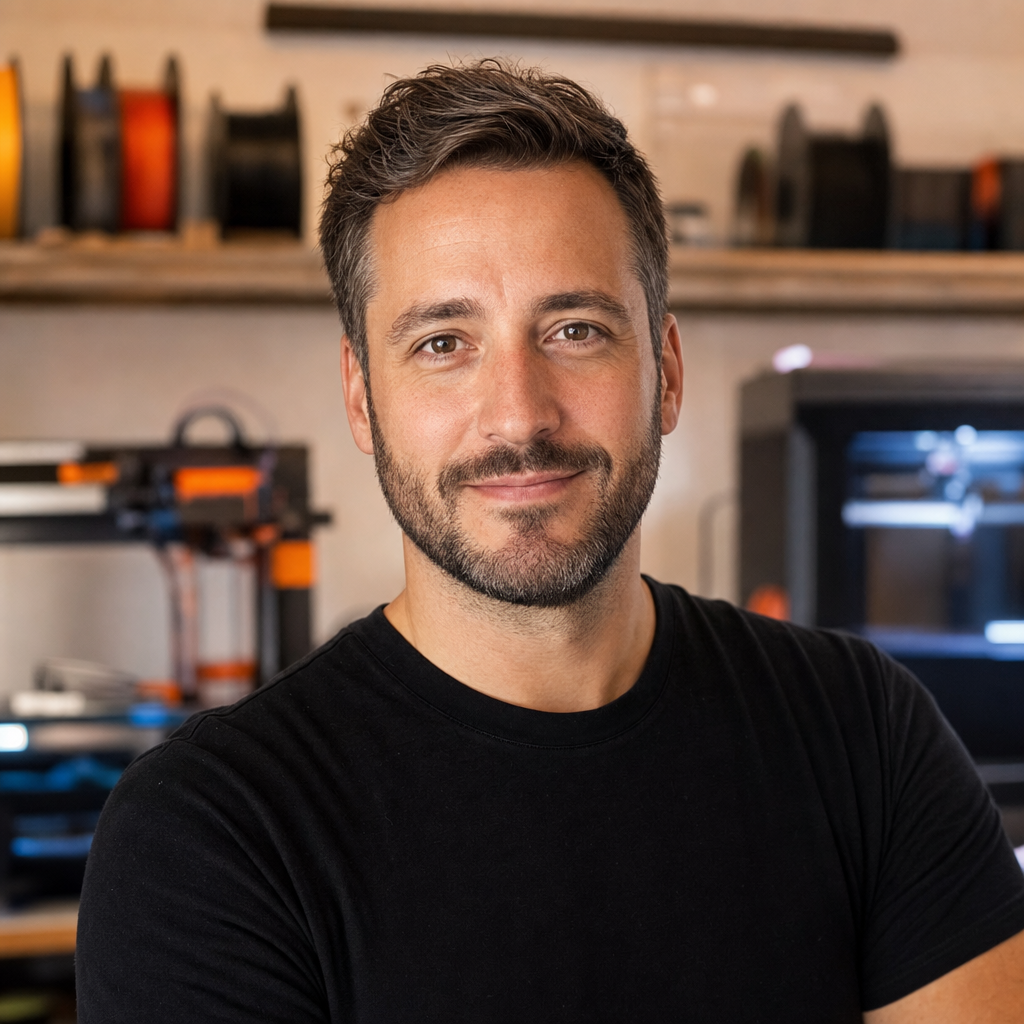
Ryan has been operating FDM 3D printers since 2017. He runs a 12-machine print farm. His daily drivers include a Bambu Lab X1 Carbon, Prusa MK4s, and Creality Ender-3 V3s that have logged over 15000 print hours. He started 3D Printer Nerd to provide structured troubleshooting guides with diagnostic order, material-specific parameters, and clear stop points.