3D Printer Value Guide: Performance Per Dollar, Not Just Sticker Price
Best value in a 3D printer isn’t the lowest price tag—it’s the machine that gives you the most reliable, capable printing per dollar for your specific projects. Whether you’re cranking out functional prototypes, cosplay armor, or small production runs, the right pick depends on where you are willing to compromise. Here are the top value choices and how to decide which one fits.
Quick answer
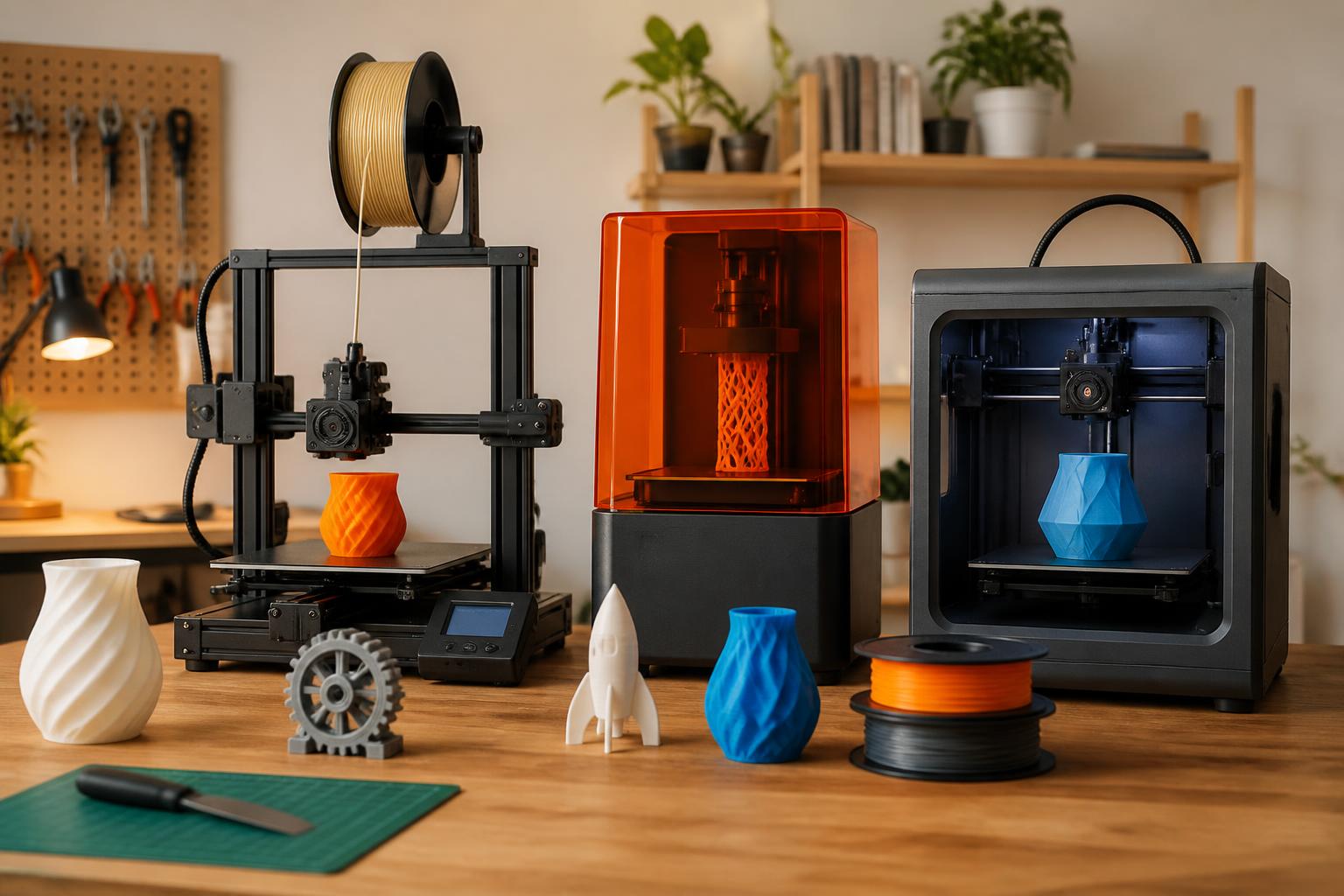
For most hobbyists, the Creality Ender-3 V3 SE (≈$200) delivers fast speeds, auto bed leveling, and solid print quality out of the box. If you need a large build volume without a huge budget, the Sovol SV08 Max (≈$400) gives you a 400 × 400 × 500 mm workspace with direct drive and Klipper firmware. For light-duty manufacturing where repeatability and surface finish matter, the Formlabs Form 4 (premium resin, >$2,000) is the value leader in accuracy and material consistency.
What this means for your next choice: If your tallest part is under 220 mm and you want minimal setup fuss, the Ender-3 V3 SE is the low-risk pick you can start printing on in 30 minutes. If you need to print a 350 mm-tall helmet in a single piece, the SV08 Max is the only sub-$500 option that fits—you’ll trade extra assembly time for the build volume. If your parts require ±25 µm tolerance and you have a budget for resin consumables (~$50–$80/L), the Form 4 saves you from outsourcing to CNC shops for short runs.
Comparison framework
The table below lays out the key specs that separate the top value picks. Prices are approximate and street prices vary; always verify current deals and bundle options.
| Feature | Creality Ender-3 V3 SE | Sovol SV08 Max | Formlabs Form 4 |
|---|---|---|---|
| Technology | FDM (filament) | FDM (filament) | SLA (resin) |
| Build volume | 220 × 220 × 250 mm | 400 × 400 × 500 mm | 203 × 203 × 266 mm |
| Typical price | ~$200 | ~$400 | ~$2,500+ |
| Max print speed | 300 mm/s (claimed) | 250 mm/s (firmware-limited) | N/A (laser scanning, speed less relevant) |
| Layer height | 0.12–0.28 mm (0.4 mm nozzle) | 0.1–0.3 mm | 15–25 µm |
| Auto bed leveling | Yes (CR Touch) | Yes (inductive sensor) | N/A (resin setup is different) |
| Firmware | Marlin (pre‑flashed) | Klipper (open) | Proprietary |
| Material compatibility | PLA, PETG, TPU, ABS (enclosure needed) | PLA, PETG, TPU, ABS, PC, Nylon | Standard, engineering, and specialty resins |
How to verify fit for your project: Measure the tallest dimension of your largest intended part. If it exceeds 220 mm, cross the Ender-3 V3 SE off your list—even with a 0.28 mm layer height you cannot print a single piece over 250 mm. The SV08 Max can handle 500 mm single-piece prints, but check that your part’s footprint fits within 400 × 400 mm. For resin, measure the part’s bounding box against 203 × 203 × 266 mm; resin also requires canting for supports, which consumes extra vertical space.
Best-fit picks by use case
For the budget hobbyist: Creality Ender-3 V3 SE
If you’re new to 3D printing or just need a reliable workhorse for parts that fit in a shoebox, start here.
- What you get: A 220 mm³ build volume, 300 mm/s travel speed, and a 60 W ceramic heater that hits 260°C hotend in seconds. The CR Touch probe means no more manual paper-leveling dance.
- Slicer settings to expect: PLA at 200–220°C nozzle, 50–60°C bed, 0.2 mm layer height, 0.4 mm nozzle. Retraction around 0.8 mm at 40 mm/s helps with stringing.
- Best part: You can move from unboxing to your first benchy in under 30 minutes.
- Watch out: The stock Bowden tube can cause heat creep with PETG over 240°C. Replacing it with a Capricorn tube ($10) is cheap insurance. Build volume is too small for helmets or large cosplay pieces.
Realistic mismatch: If you ever plan to print ABS or Nylon, the open-frame design causes warping and layer delamination. A DIY enclosure adds $30–50 and several hours of build time. Without one, ABS prints will likely lift from the bed on corners larger than 50 mm.
For the large-format enthusiast: Sovol SV08 Max
When your projects outgrow 220 mm, the SV08 Max delivers a 400 mm³ build plate for about what you’d spend on a mid‑range Ender upgrade package.
- Key specs in practice: Direct-drive extruder handles flexible filaments like TPU without jams. Klipper firmware lets you tune pressure advance and input shaping for clean corner definition on tall prints. Dual Z‑axis steppers prevent binding on heavy gantries.
- Print recommendations: PLA at 200–215°C, bed 60°C, 0.2 mm layer height. For large cosmetic props, try 0.28 mm layers to cut time in half.
- Trade-off: Assembly takes 3–4 hours (frame, belts, wiring). Expect to calibrate e‑steps, PID, and Z-offset manually. The open-frame design drafts easily; an enclosure is strongly recommended for ABS or Nylon.
- Concrete verification step for calibration: After assembly, use a 20 mm calibration cube to check dimensional accuracy. If it measures 20.2 mm on X or Y, adjust e‑steps and tighten belt tension until it’s within 0.1 mm. Running a bed-level visual layer test (three circles in corners) confirms the Z‑offset before a real print.
For light‑duty manufacturing: Formlabs Form 4
If your parts need tight tolerances ( ± 25 µm), smooth surface finish, or mechanical properties that only engineering resins provide, the Form 4 is the best value in precision resin printing.
- What makes it worth the price: Formlabs offers a mature material ecosystem—over 30 resins including Tough 2000, Flexible 80A, and castable wax. The Low Force Display™ reduces peel forces, so delicate features don’t snap off. Build volume is 203 × 203 × 266 mm, small but tall enough for dental models or jigs.
- Workflow: PreForm slicer auto‑generates supports and orientation. Print failure rate is near zero with factory settings. Post‑processing requires washing in IPA and curing under UV light (Form Wash and Cure are optional add-ons).
- When to skip it: If your parts are purely aesthetic, a well‑tuned FDM printer with a 0.2 mm nozzle can approach resin quality at a fraction of the cost. Also, resin costs $50–$80 per liter and gloves/ventilation are mandatory.
Hidden trade-off you’ll feel in your wallet: The Form 4 is locked to Formlabs proprietary resin cartridges—no third-party alternatives are recognized. A typical 1L cartridge costs $80 and yields about 30–40 small parts (depending on support density). For a 200-part prototype run, resin alone can cost $400–$600. Make sure your per-part budget can absorb that before buying into the ecosystem.
Trade-offs to know
- Speed vs. quality: The Ender-3 V3 SE can sprint at 300 mm/s, but acceleration limits (5,000 mm/s²) mean actual print times for a 200 mm tall vase are ~3 hours faster than the SV08 Max at normal speeds. In contrast, the Form 4 takes 4–8 hours per build plate but delivers near-injection-mold surface finish.
- Open vs. closed ecosystem: Sovol and Creality machines run open firmware and accept any brand of filament. The Form 4 is locked to Formlabs resins and proprietary cartridges. While the resins are well‑validated, per‑liter cost stays high.
- Tinkering vs. walk‑away reliability: The Ender-3 V3 SE is largely plug‑and‑play for PLA, but you’ll still tighten belts, tram the gantry occasionally, and swap nozzles. The SV08 Max requires a deeper understanding of Klipper to get the most out of it. The Form 4 requires minimal user intervention—just load a cartridge and hit print—but you pay for that simplicity in consumables.
- The single decision criterion that changes the recommendation: print volume vs. budget. If you absolutely need to print a single piece 350 mm tall (e.g., a helmet), the $400 SV08 Max is the only value choice. If all your parts fit inside 150 mm, the $200 Ender-3 V3 SE is a better value per quality. If your parts need 25 µm detail and engineering properties, the $2,500 Form 4 can actually save you money compared to outsourcing CNC or injection molding for small runs.
Practical implication for the “buy once” mindset: If you think you might need large parts later, the SV08 Max is the only forward-looking value pick under $500. A $200 Ender cannot grow, and a $2,500 Form 4 is overkill if your largest part is a 30 mm bracket. Measure your next six months of projects before deciding.
Related questions
Is the Sovol SV08 Max worth it for a beginner?
Only if you are comfortable assembling a printer from parts (frame, wiring, belts) and learning Klipper via the web interface. The manual is sparse, and common fixes rely on community forums. Beginners are better off with the Ender-3 V3 SE first, then upgrading.
What’s the best value 3D printer for under $300?
The Creality Ender-3 V3 SE is the clear winner. Its auto leveling, fast heating, and up to 300 mm/s speed match printers costing twice as much. The only similarly priced competitor is the Elegoo Neptune 3 Pro (≈$200), but it has a smaller community and slower travel speeds.
Are resin printers better value than FDM printers?
For prototyping or low-volume parts that need high detail, yes—if your parts fit in a 200 mm cube. Resin costs roughly 5–10× more per part than FDM, and post‑processing adds time. For functional prototypes that require dimensional stability or heat resistance, FDM with PETG, ABS, or polycarbonate is often better value per part.
How do I confirm my part fits before ordering the printer?
Use a ruler or caliper to measure the tallest dimension of your part. Add 10 mm clearance for the print head travel. For resin, add 15 mm for supports and orientation tilt. Compare against the printer’s build volume in the table above—if any dimension exceeds the listed limit, the printer cannot produce that part in one piece.
Explore This Topic
- Back to Best 3D Printers
- Back to sc0007
Related guides in this cluster:
- 3d print best: Top Picks & Guide
- Best 3d printer multicolor: Top Picks & Guide
- Best beginner 3d prints: Top Picks & Guide
Ryan has been operating FDM 3D printers since 2017. He runs a 12-machine print farm. His daily drivers include a Bambu Lab X1 Carbon, Prusa MK4s, and Creality Ender-3 V3s that have logged over 15000 print hours. He started 3D Printer Nerd to provide structured troubleshooting guides with diagnostic order, material-specific parameters, and clear stop points.